


High mudguards and knobbly tyres alone are not the perfect recipe for the ditch-jumper of your dreams. Here’s what you need to build the perfect scrambler
How to build a scrambler: here are the most useful tips:
Just looking at them inspires endless journeys and routes without boundaries: no, we’re not talking about maxi-enduros — we’ll leave those at the top of the market and, above all, to “conventional” riders (just kidding, editor’s note) — but about scramblers. So, after a brief recap of history, let’s see what ingredients are needed to create a bike with impeccable looks but real ability too.
The origins
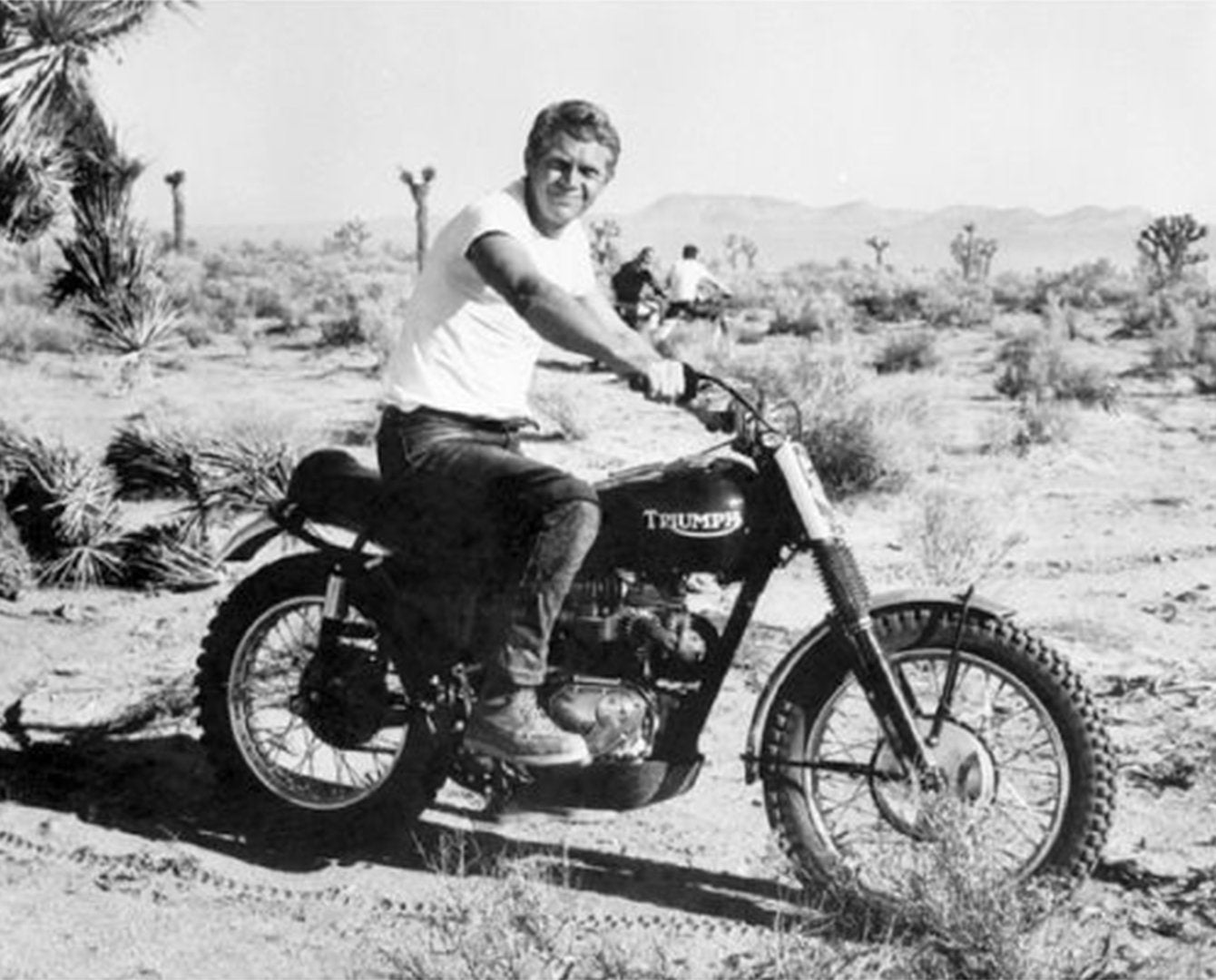
Born in the United States at the start of the fabulous ’70s, scramblers were customised to “make a virtue of necessity”. Riders of the time modified road-going roadsters to make them capable of tackling the taped-off tracks of ranches or the dunes of the American desert areas.
Once in the garage, the bike underwent a truly radical transformation: the original rims were replaced with a spoked pair, better still if the front wheel was larger than the rear. Fitted to the new rims, of course, had to be knobbly tyres, or for those who “hung around” the canyons, even trials tyres.
The front mudguard was raised to stop mud from cracking it or blocking the wheel’s movement; the exhaust was raised too, to prevent damage on rocks or natural steps and above all to avoid taking on water when crossing fords.
Tall handlebar with cross brace, suspensions derived from specialist bikes to make the most of the increased travel, and engine guards put the finishing touch to true two-wheeled Frankensteins that, even today, still have tremendous appeal.
The right choice
Today things have changed a little, rightly or wrongly: those who want a scrambler do so for the style and looks, and few actually take them off to get dusty on gravel roads and mule tracks. And if you’ve read this far, perhaps it’s because having a scrambler in the garage wouldn’t be such a bad thing after all.
There are two paths here
- Buy a bike that already draws on the scrambler world even in standard form, such as the Triumph Street Scrambler, Ducati Scrambler, Benelli Leoncino Trail or Royal Enfield Interceptor, and then make a few small changes to make it even more appealing in your eyes.
- Or start with an older bike, one that does not already embody scrambler styling, and begin creating your own special.
In the latter case, there are a few pieces of advice that may seem obvious, but judging by the pages of Facebook groups or the threads on certain forums, they are not so obvious after all, and above all they help you define what SCRAMBLER is and, more importantly, what it is not.

Here is our short decalogue on how to build a scrambler:
- A pair of knobbly tyres is not enough to turn a naked bike into a scrambler.
- A braced handlebar is not enough to turn just any bike into a scrambler.
- With a 4-cylinder engine (or worse, 6), you do not get a scrambler, but a mechanical sacrilege (and a coffin on wheels in the event of off-road riding).
- The Honda CB Four models are the exception that proves the previous rule.
- If you are thinking of turning a sports bike or a faired bike into a scrambler, stop.
- If you are thinking of turning a road tourer into a scrambler, stop.
- For owners of BMW K series models: read all the previous points aloud again.
- A scrambler with a single-sided swingarm is not a scrambler.
- If it has clip-ons, it is not a scrambler.
- Please leave the Honda Dominator and old Japanese motocross bikes from the ’80s alone: they are beautiful as they are and have already suffered enough.
Yes, perhaps we were a little strict, but we do it out of love for the genre. :)
Buying advice
So, if we want to start from scratch, what should we bring into the garage? Well, the choice is wide and here we will briefly recap just some of the possibilities.
You can start with older models, such as Yamaha XS in various engine sizes, BMW della serie R from the late ’70s and ’80s, Suzuki XF 650, Honda XR650 as well as Moto Guzzi V35, Triumph Bonneville and many more besides.
As we have already written, you can opt for modern models that are already close to scrambler styling cues, but you can also turn towards a type of motorcycle that has unfairly been forgotten over the years: Big Monos.
They enjoyed success right through the ’80s, managed to survive the ’90s, but today, apart from the Husqvarna Svartpilen 701, no one focuses on large-capacity single-cylinder bikes anymore.
big mono bikes vibrate, are not excellent at very low revs, often tend to wheelie and make quite a lot of noise, but they also have flaws.
If you want one of them as a starting point, the most reliable names are: Suzuki DR-Z 400 (as well as the DR 650), Yamaha XT 660, Kawasaki KLR 650, Honda XL 600 (I repeat: let the Dominator grow old in peace).
Let’s get started!
We may be biased, but we repeat it at every opportunity: if you do not have sufficient experience and practical skills, leave it to us, or to colleagues in the sector, because the risk of a dream quickly turning into a nightmare of leftover bolts and bikes falling to pieces is real and common.
That said, the ingredients for the perfect scrambler are not many, and above all they depend on how you are going to use the bike.
If you want a scrambler for its look but have no intention whatsoever of venturing into woods and trails, then the following will be enough:
- High front mudguard
- Short rear mudguard
- High exhaust
- Handlebar with cross brace
- Knobbly tyres
- Headlight guard and, if desired, a flyscreen
- Side number boards (which replace the original ones when needed)
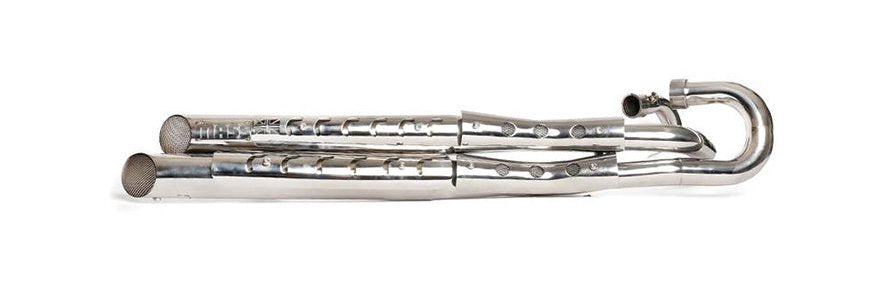 If, on the other hand, you want to get your beauty covered in mud and dust, then it would also be a good idea to fit:
- Spoked wheels
- Engine guards (side and lower)
- Handguards
- Handlebar pad
- Oversized or folding foot pegs
There is one, and only one, reason all these accessories have in common: you will fall. Slowly or hard, awkwardly or after doing something unbelievable, but you will fall. And that is part of the beauty of off-road riding too.
Scrambler Made in Britain!
Naturally, when it comes to motorcycles, we have tea with Queen Elizabeth, so it is no secret that British bikes hold no secrets for us.
And the reason to choose them is simple; they are more suited to customisation. No single-cradle or box-section frames, which make it difficult to give a scrambler an impeccable look, but rather the good old tubular frames that are so well suited to this kind of work.
The chassis helps too: both the modern classics from Triumph and the Royal Enfield models have twin rear shock absorbers, which fit perfectly within scrambler styling cues. And then there is the engine: British twins pack plenty of punch, are manageable everywhere and above all reliable. The result? Well, to get an idea, take a look at our Gravel.
[caption id="attachment_5115" align="alignnone" width="1350"]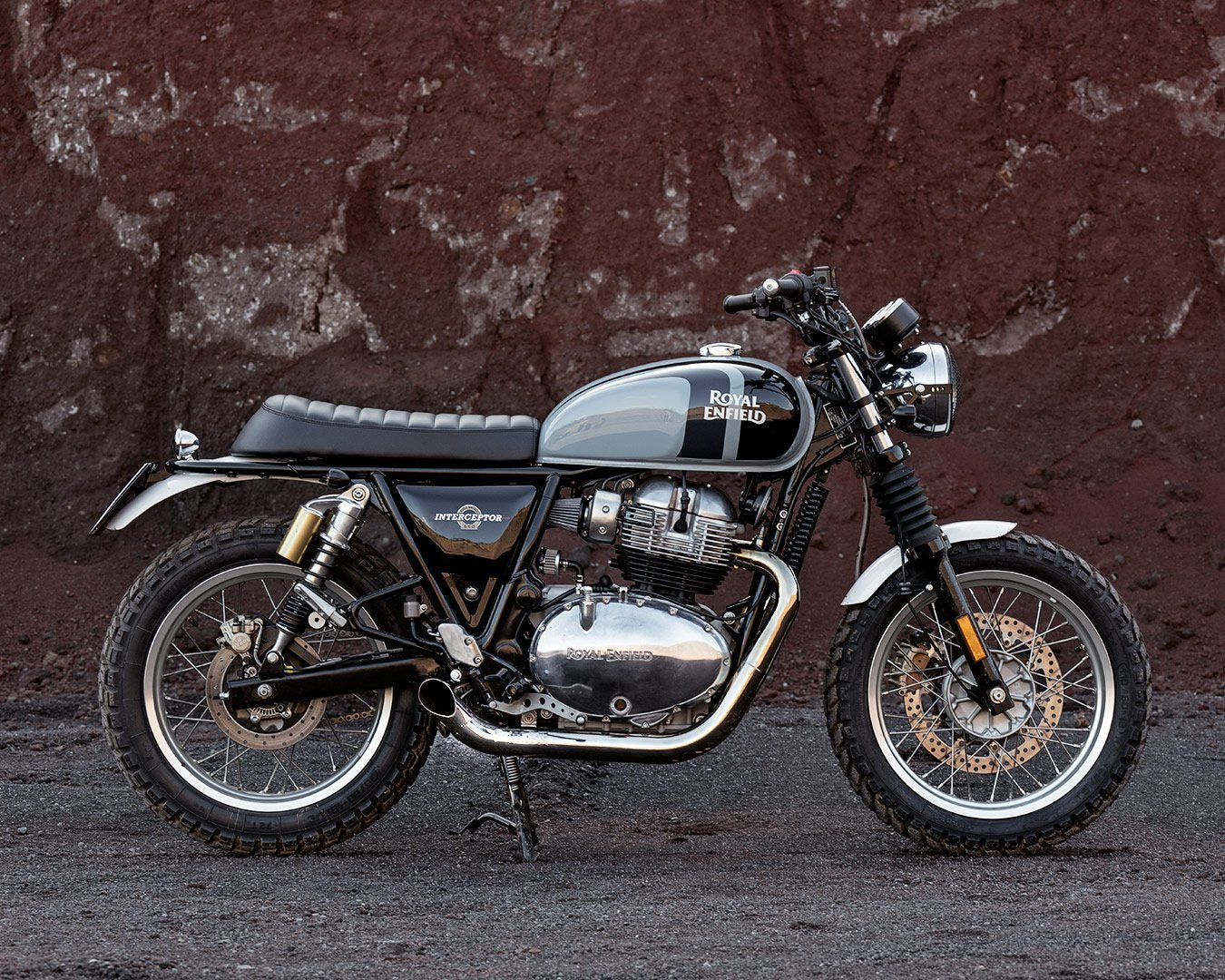 Interceptor "Gravel" by Cafe Twin[/caption]


